Sarah Palin: "America's Enduring Strength" from Sarah Palin on Vimeo.
Wednesday, January 12, 2011


Friday, December 31, 2010
retract it, scientist.
 Fine, Annie and Jeff Morrow, I'll admit to being wrong about "All of the Lights." It's good. But it still doesn't crack my favorites.
Thursday, December 30, 2010
Wednesday, December 29, 2010
these are what new yorkers talked about?

Really? I guess I'm out of touch, because I genuinely don't think I really cared about any of these things. Wow, that sounds awesomely old and crotchety. But I stand by it.
Tuesday, December 28, 2010
Black Swan
The metaphoric framing device that is the premise for Black Swan is inherently and relentlessly Manichean. It is therefore satisfying on many levels (glorious and easy structurally, allows for simple categorization and identification of characters), but also left me feeling unsure how to feel about this film, and wondering whether I was (or should be) annoyed. Black Swan vs. White Swan. Overachieving Nina (Natalie Portman) is too much the frigid, perfectionist White Swan to successfully "let go" and "loose herself" in the seductive, dangerous character of the Black Swan. But she desperately wants to dance it, so she experiments and spins herself into a vortex of self-exploration (in this case, synonymous with destruction) in order to dance the role--which apparently, she can only do once she has completely lost it.
My feathers get ruffled (apologies for sticking with Aronofsky's metaphor) any time I am presented with the frigid-uptight-perfectionist and the sexy-dangerous-vixen female archetypes set in opposition to each other. It is an overly simplistic view of female motivations, behavior and sexuality. And knowing (or perhaps assuming) Aronofsky is too smart for this, it left me wondering if instead he was parodying this dualism. In which case, rather than taking offense should I just be ironically amused? The simplification of female sexuality and it's inherent misogyny is one of my favorite ironic amusements!
More central to the film's theme is yet another related duality. The conflict between the Apollonian and the Dionysian as it relates to the arts. Nina begins as a classicist. She is technically perfect. However, she is unable to give in to her inner darkness, her inner seductiveness. As she dances, she is not dangerous enough to give an inspiring performance. For homework, her sleazy and charismatic choreographer instructs her to touch herself. Somehow, that will make her a better artist. And as she goes on a bender, she only gets better and better. This brings up the Romantic ideal of the "tortured artist." Must artists be destructive, dangerous wrecks in order to create great art? In Nina's case, the answer is yes. To frame this as either-or, is troubling. Either one is technically perfect, but soulless and uninspired, or self destructive and transcendent. This is a duality that many involved in the arts seem to believe. And my stomach turned when the choreographer told Nina to "let go" and "loose herself", as I have heard those phrases told to me and numerous others countless times by somewhat patronizing and self satisfying acting gurus. I mean, teachers.
However, perhaps the nuance in these dualities is that in both instances, Nina is destructive. In her Apollonian phase she destroys herself by self mutilating and through eating disorders, in her Dionysian phase it's through drugs and sex. In Manohla Dargis' review she implies that those who are too bothered by or hung up on these simplifications would be in fact simplifying the movie and missing the depth of it. Perhaps that is true. Perhaps this is not so much a film about what it takes to be an artist (as a woman?) as it is a slightly trashy horror film about the limitations of the dualisms that so often pervade the arts. And despite my questions about what the film is implying about art and gender, I do have to admit that I really enjoyed it, in all of its terrifying salaciousness and easily identifiable categories and archetypes.
For further thematic resonance see also:
-"The Hitchhiking Game" by Milan Kundera
-Goodbar --a rock/theater piecethat deals with similar issues and themes and is generally fantastic and disturbing.
My feathers get ruffled (apologies for sticking with Aronofsky's metaphor) any time I am presented with the frigid-uptight-perfectionist and the sexy-dangerous-vixen female archetypes set in opposition to each other. It is an overly simplistic view of female motivations, behavior and sexuality. And knowing (or perhaps assuming) Aronofsky is too smart for this, it left me wondering if instead he was parodying this dualism. In which case, rather than taking offense should I just be ironically amused? The simplification of female sexuality and it's inherent misogyny is one of my favorite ironic amusements!
More central to the film's theme is yet another related duality. The conflict between the Apollonian and the Dionysian as it relates to the arts. Nina begins as a classicist. She is technically perfect. However, she is unable to give in to her inner darkness, her inner seductiveness. As she dances, she is not dangerous enough to give an inspiring performance. For homework, her sleazy and charismatic choreographer instructs her to touch herself. Somehow, that will make her a better artist. And as she goes on a bender, she only gets better and better. This brings up the Romantic ideal of the "tortured artist." Must artists be destructive, dangerous wrecks in order to create great art? In Nina's case, the answer is yes. To frame this as either-or, is troubling. Either one is technically perfect, but soulless and uninspired, or self destructive and transcendent. This is a duality that many involved in the arts seem to believe. And my stomach turned when the choreographer told Nina to "let go" and "loose herself", as I have heard those phrases told to me and numerous others countless times by somewhat patronizing and self satisfying acting gurus. I mean, teachers.
However, perhaps the nuance in these dualities is that in both instances, Nina is destructive. In her Apollonian phase she destroys herself by self mutilating and through eating disorders, in her Dionysian phase it's through drugs and sex. In Manohla Dargis' review she implies that those who are too bothered by or hung up on these simplifications would be in fact simplifying the movie and missing the depth of it. Perhaps that is true. Perhaps this is not so much a film about what it takes to be an artist (as a woman?) as it is a slightly trashy horror film about the limitations of the dualisms that so often pervade the arts. And despite my questions about what the film is implying about art and gender, I do have to admit that I really enjoyed it, in all of its terrifying salaciousness and easily identifiable categories and archetypes.
For further thematic resonance see also:
-"The Hitchhiking Game" by Milan Kundera
-Goodbar --a rock/theater piecethat deals with similar issues and themes and is generally fantastic and disturbing.
Friday, December 24, 2010
Under the hood of lymph nodes and tumors
Two quick thoughts.


 It turns out that pancreatic adenocarcinoma is characterized by a very potent proliferation of fibroblasts. Olive hypothesized that the stromal cells might actually create a physical barrier against drug entry. So he treated mice with a small molecule inhibitor of smoothened, a member of the sonic hedgehog pathway that is critical for fibroblast proliferation. And indeed, he found that when fibroblast growth was inhibited, the pancreatic tumors became more vascularized, more perfused with chemotherapeutic drugs, and the mice lived longer. This drug is now in accelerated phase II trials. It's not a cure, but it is a great example of out-of-the-box thinking.


1. A Physical Barricade in Pancreatic Cancer
A couple of weeks ago, I met Kenneth Olive at Columbia, who spoke about the following story coming out of his lab:

Basically, Olive looked at the (dismal) fact that pancreatic cancer seems to be resistant to almost every kind of chemotherapy. The current standard of care, gemcitabine, extends survival by about two weeks. He started studying how pancreatic cancer in mice. As expected, treating mice with pancreatic tumors with gemcitabine didn't do much. However, Olive noticed that if he took pancreatic cancer cells out, grew them in a dish, and transplanted them into the skin of another mouse, they suddenly became sensitive to gemcitabine. So he wondered if maybe the issue wasn't that the cancer cells were resistant to the drug, but rather that the drug just couldn't get into the tumor.
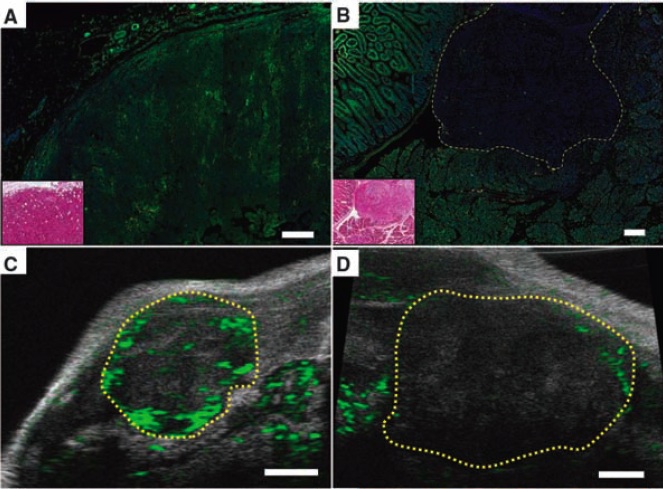
So he looked at tumors that were either in the pancreas (b/d, left) or transplanted subcutaneously (a,c). He found that doxorubicin (used because it autofluoresces green) rapidly entered transplanted but not native tumors. When he imaged the tumors by ultrasound (c,d), he found similarly that blood flow into native tumors was minimal.
 It turns out that pancreatic adenocarcinoma is characterized by a very potent proliferation of fibroblasts. Olive hypothesized that the stromal cells might actually create a physical barrier against drug entry. So he treated mice with a small molecule inhibitor of smoothened, a member of the sonic hedgehog pathway that is critical for fibroblast proliferation. And indeed, he found that when fibroblast growth was inhibited, the pancreatic tumors became more vascularized, more perfused with chemotherapeutic drugs, and the mice lived longer. This drug is now in accelerated phase II trials. It's not a cure, but it is a great example of out-of-the-box thinking.
2. Looking deeper into B cell development
I don't really know that much about B cells, but I know enough to appreciate my pal Gabriel Victora's landmark study in Cell last month, titled, "Germinal center dynamics revealed by multiphoton microscopy with a photoactivatable fluorescent reporter." Basically, B cells undergo antigen recognition in lymph nodes where they assemble into histologically visible cellularly dense structures called 'germinal centers.' Germinal centers are composed of a 'light zone' and 'dark zone' based on how they look on histology slides. When B cells see antigen, they begin to undergo a process known as 'affinity maturation' in which they undergo rapid mutation (somatic hypermutation) of the antigen-recognizing sequences on their immunoglobulin receptors. Somehow, this results in survival of only high affinity B cell clones in a process that somehow involves both T cells and follicular dendritic cells. How this relates to creation and maintenance of the light and dark zones of the germinal center was suspected, but not known, until this study from Victora and colleagues.
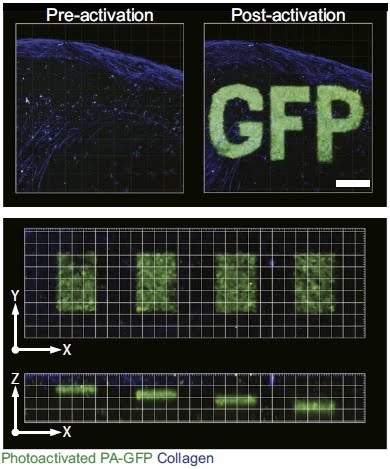
First and foremost, the authors developed a technique in which they could use two-photon microscopy to sensitively apply a light stimulus to specific regions of the lymph node. That light stimulus would then uncage a photoactivatable fluorescent reporter, GFP, only in cells receiving the stimulus (specificity shown awesomely to the right). Read here to see why two-photon microscopy is critical to this process - basically, it can more efficiently target light to a single plane.
Victora and colleagues used this technique to differentially activate only cells in the light or dark zone of germinal centers. Keep in mind - this is the first time that light and dark zone cells could be discriminated while still alive. Using this technology, they were able to assess differential surface protein expression as well as gene expression in light and dark zone B cells.

What they found was that the dark zone B cells expressed more genes related to mitosis (consistent with the idea that cells in the dark zone are rapidly proliferating) whereas light zone B cells expressed more molecules related to activation and apotosis, suggesting that this is where B cells undergo antigen recognition and selection.
Next, Victora and colleagues used this photoactivatable technique to track migration of B cells between the dark and light zone.

They found that B cells moved rapidly from the dark zone to the light zone, repopulating the light zone within about six hours, but more slowly from the light zone to the dark zone. Finally, they showed that survival of B cells in the light zone was critically dependent on presentation of antigen on MHC-II molecules to T cells in the light zone. Based on this, Victora and colleagues presented an integrated model for affinity maturation of B cells in germinal centers. B cells acquire antigen by moving from the dark zone to the light zone where they migrate along follicular dendritic cells. As they divide and their Ig receptors undergo SHM, the cells that develop higher affinity receptors are able to capture more antigen, present more antigen to T cells, and therefore receive more T cell help. These are the B cells which survive, return to the dark zone, and undergo proliferation. Kudos to Gabriel and the members of the Dustin and Nussenzweig labs who worked on this super-cool project.
Thursday, December 23, 2010
gene therapy
 It's a bit embarrassing to admit, but the phrase "gene therapy" provokes a fear response, even in me, a geeked out science-type. I blame Jeff Goldblum. Between 'The Fly' and intoning "nature...finds a way" as the chaos theory-loving Ian Malcolm, he's trying to poison us all against the potential of gene therapy (OK, I guess in the latter case he's just the engaging voice box for Michael Crichton, who tried to convince us that science invariably leads to unstoppably virulent organisms, rampaging dinosaurs, or some kind of mind control).
 Well, don't let that get you down. The history of gene therapy, like the history of cancer, is full of paradigm shifts, hubris leading to inappropriate institution of therapy, and, ultimately, some very exciting progress.
Successful gene therapy starts somewhere around 1971 with the publication in Nature of a report by Carl Merril and Mark Geier at the NIH titled "Bacterial virus gene expression in human cells." In this report, they isolated fibroblasts from a patient with galactosemia (an inability to break down galactose which results from a deficiency of an enzyme called a-D-galactose-1-phosphate uridyl transferase). They then took a virus called a lambda phage (a virus which typically infects e.coli) containing the genetic material to encode this enzyme, and exposed the patient's fibroblasts to it. Lo and behold, the fibroblasts developed the ability to break down galactose; this was the first evidence, in a petri dish, of therapeutic transfer of genetic material to human cells. A few years later, another group published a report in the Journal of Experimental Medicine, in which they were able to correct hyperargininemia in human fibroblasts via infection with the Shope papilloma virus (which, interestingly, generates keratin-rich head and neck tumors rabbits, which are likely the origin of anecdotal reports of "jackalopes"). Interestingly, this same group attempted to treat patients with hyperargininemia with Shope papilloma virus infection, unsuccessfully.
 Nevertheless, the success achieved in vitro with human cells led to features in the New York Times in the early 1970s which speculated on the possibility of gene therapy. One piece, titled "Altering the cell - the vistas are breathtaking" wondered, "Can such inherited disorders be cured by chemically altering the genes?" (This piece also featured some awesome not-so-PC jargon, referring to 'genetic defects such as mental retardation' and describing DNA as 'the universal genetic material, active stuff of the genes and chromosomes.') Even at this point, speculators balanced hope ("We might be able some day to turn genes on and off at will - and that, of course, will be a real breakthrough in medical treatment") and trepidation ("Such attempts, often called 'genetic engineering,' are viewed with suspicion by some who believe that they might someday be misused either intentionally or through lack of sufficient knowledge of the consequences.')
At this point, the mix of excitement and reticence was mirrored in the scientific community. A review by Friedmann and Roblin in Science titled "Gene therapy for human genetic disease?" cited a number of potential pitfalls:
"How will we ensure that the correct amount of enzyme will be made from the newly introduced genes? Will the integration event, linking exogenous DNA to the DNA of the recipient cell, itself disturb other cellular regulatory circuits? Third, the patient's immunological system must not recognize as foreign the enzyme produced under the direction of the newly introduced genes. if this occurred, the patient would form antibodies against the enzyme protein."
They also worried about obtaining proper consent, given the fact that, at least initially, gene therapy might primarily target infants with genetic diseases whose parents might not always be emotionally capable of providing appropriate consent. Given these concerns, they preached significant caution ("We are aware...that physicians have not always waited for a complete evaluation of new and potentially dangerous therapeutic procedures before using them on human beings.")
 Another fifteen years passed before gene therapy successfully achieved a remission. Patient Zero was a Ashanti DeSilva, a four-year old girl born with severe combined immunodeficiency (SCID) secondary to adenosine deaminase deficiency. French Anderson at the NIH obtained FDA approval for autologous transplant of her bone marrow, retrovirally infected with the gene for adenosine deaminase. As seen on the left, a report four years later published in Science demonstrated sustained lymphocyte persistence (as evidenced by productive antibody responses to various antigens), but more importantly, quality of life improvement:
"Patient 1, who had been kept in relative isolation in her home for her first 4 years, was enrolled in public kindergarten after 1 year on the protocol and has missed no more school because of infectious disease than her classmates or siblings."
Gene therapy trials continued to progress until, as tends to happen when a new medical therapy shows significant promise, it began to be implemented in situations where the risks outweighed the benefits. Which brings us to the tragic story of Jesse Gelsinger.

I certainly can't detail the story of Jesse Gelsinger better than the New York Times did in a 1999 piece titled, "The biotech death of Jesse Gelsinger." In brief, Gelsinger was a seventeen year old who suffered from a partial deficiency of ornithine transcarbomylase an critical enzyme in the metabolism of nitrogenous waste. In patients with a complete lack of this enzyme, ammonia builds up to toxic levels, causing encephalopathy and death during infancy. Gelsinger's defect was not lethal, however; it was well-controlled with a low-protein diet and enzyme replacement. He chose to enroll in a phase 1 trial in which the enzyme would be delivered with an adenoviral vector (adenovirus is a common cause of seasonal cold in animals and humans) in the hopes that gene therapy could eventually save infants with a complete OTC deficiency. Unfortunately, in what was later determined to be a massive immune response to the adenoviral packacking, he developed fulminant multi-organ failure and eventually died. This devastating event served as a necessary check on the overzealousness of those implementing gene therapy by reminding everyone of the potential risks involved.
At around this time, a man named Carl June was working in the lab of Larry Samelson at the National Cancer Institute. June and Samelson collaborated to uncover many of the basic tenets of T cell signaling; they established the link between phosphorylation of tyrosine residues in the cytoplasmic tails of the TCR complex and downstream activation of phospholipase C, the required predecessor of intracellular calcium elevation and autocrine production of IL-2.
By the time June reached the University of Pennsylvania (where Gelsinger had received gene therapy), he had moved on to the goal of engineering targeted immune cells for treatment of cancer and autoimmune disease. In 2003, he developed a technique for ex vivo expansion of T cells using MHC-Ig fusion proteins coated on polystyrene beads. Subsequently, he was able to use these ex vivo expanded T cells to reconstitute immunity in lymphopenic individuals following high dose chemotherapy-induced myelosuppression. By the time 2006 rolled around, and the first report of cancer regression using adoptive transfer was reported in Science (using cytotoxic lymphocytes retrovirally infected with a T cell receptor against the melanoma antigen MART-1 which had been obtained from tumor-infiltrating lymphocytes from a patient who received polyclonal T cells and achieved a near-complete remission), June was using ex-vivo expanded T cells to achieve remissions in patients with refractory ALL, AML, CLL, and Non-Hodgkin lymphoma without a complementary increase in GVHD. But June didn't limit his target to cancer. That same year, he piloted a therapy of transferring CD4+ T cells transfected with an antisense oligonucleotide to the HIV envelope protein Env in order to make them resistant to HIV infection, to patients with HIV resistant to HAART.
Around the same time that Carl June was generating high-affinity cytotoxic lymphocytes for control of HIV spread, a group in Germany was pursuing gene therapy for HIV in a very different way. They had noted the requirement for HIV to bind the chemokine receptor CCR5 in order to enter CD4 T cells, as well as the naturally occuring delta32 mutant, which, when homozygous, causes a 32 base pair deletion creating an abnormally truncated protein that did not express on the cell surface and was protective against HIV infection in the population (this mutant was originally reported in 1996, in a landmark study in Nature Medicine). The German group wanted to see if repopulation of a patient's CD4 T cells with a homozygous delta32 mutant would effectively 'cure' their HIV, and they had the perfect patient: a 40-year old male with AML requiring a transplant, and HIV. Even more spectacularly, they managed to obtain bone marrow from a donor who actually was both an HLA match and homozygous for the delta32 mutant (thus not requiring them to actually do any genetic modification).

The patient tolerated the transplant well, only to relapse after 332 days. After re-induction and re-transplantation, the patient achieved a complete cytologic remission and an undetectable HIV viral load without requiring HAART therapy. They published these findings in the New England Journal of Medicine. This month, they published a follow-up study in Blood. They noted that the big problem with HAART therapy, which often achieved undetectable viral loads, was relapse once therapy was withdrawn, often due to persistence in reservoirs (most commonly the brain and lamina propria). In this follow-up paper, they showed that 3.5 years after treatment, patient 'X' had not only an undetectable viral load off HAART, but had no evidence of viral persistence on mucosal, liver, or brain biopsies.
Furthermore, T cells isolated from the patient were resistant to infection by R5-tropic, but not X4-tropic HIV. This last point is critical, and is perhaps the main criticism of this otherwise remarkable set of papers. As the authors noted, the delta 32 homozygous mutation is not typically associated with 100% HIV resistance (due to development of X4-tropic HIV strains). Particularly in a patient who was already HIV+, you would expect these strains to develop. The fact that there were still CCR5+ macrophages at day 159 should have provided evidence for potential reservoirs. It is possible that this patient simply did not have a particularly mutagenic strain; that question will be born out by future experiments.
 Which brings us to the present day. With respect to HIV, the primary focus is on engineering HIV-resistant CD4+ T cells and anti-HIV CTLs. With respect to gene therapy, however, the questions are undoubtedly more complex. Retroviruses seem to be the choice vectors due to their ability to integrate their genetic material into host DNA; the problem with retroviruses is that this integration is random and can cause 'insertional mutagenesis' by either disrupting vital genes or causing overexpression and transformation of proto-oncogenes. One method that has been used to direct genetic insertion is the use of zinc finger nucleases, which direct DNA cleavage (and subsequent viral gene insertion) to specific domains based on their requirement for homodimerization. Additionally, the use of lentiviral vectors, which are able to infect non-dividing cells, yet seem to minimize insertional mutagenesis, has improved both the safety and efficacy of viral vector-based gene transmission.
 Meanwhile, Carl June's group continues to try to optimize adoptive cell transfers for immunotherapy of liquid tumors. They have shown that the balance and T effector versus T regulatory cells appears to govern anti-AML immunity and that suppression of the extracellular death signal PD-1 seems to enhance survival of adoptively transferred T cells. However, they have also started to transition into other forms of T cell engineering. For example, they noticed that T cell receptors often have relatively low affinity for tumor antigens; therefore, they developed so-called "chimeric antigen receptors" or CARs, which have high-affinity extracellular ligand-binding domains and intracellular domains which not only drive T cell signaling (via CD3-zeta IC domains) but also T cell survival (via CD28 or 4-1BB IC domains). These CARs can be expressed via either retroviral infection or direct electroporation of CAR mRNA, and have critical roles in both anti-tumor immunity and prevention of chronic disease. For example, June's group has developed regulatory T cells with CARs which express extracellular antibodies against autoreactive TCRs and intracellular CD3-zeta domains. They therefore induce potent T cell suppression when activated by autoimmune TCRs and are of potential use for refractory autoimmune disease.
  One might feel that these high-affinity CARs might predispose these T cells to autoimmune disease, but June's CAR group has protected against that as well, by expressing HSV-tyrosine kinase in their infectious virions; therefore, T cells that express CARs will also be sensitive to HSV-TK targeting by ganciclovir. Finally, T cell immortality appears to be dependent on maintenence of telomere length; expression of CD28 intracellular domains and exposure of T cells to IL-15 in culture appears to maintain telomere length and was shown to induce immune cell immortalization without malignant transformation. This should prove highly useful in immunotherapeutic efforts against neoplastic disease.
Yikes. I am way too wordy.
Subscribe to:
Posts (Atom)